Karachi to Launch Modern Urban Management System with Chinese Expertise
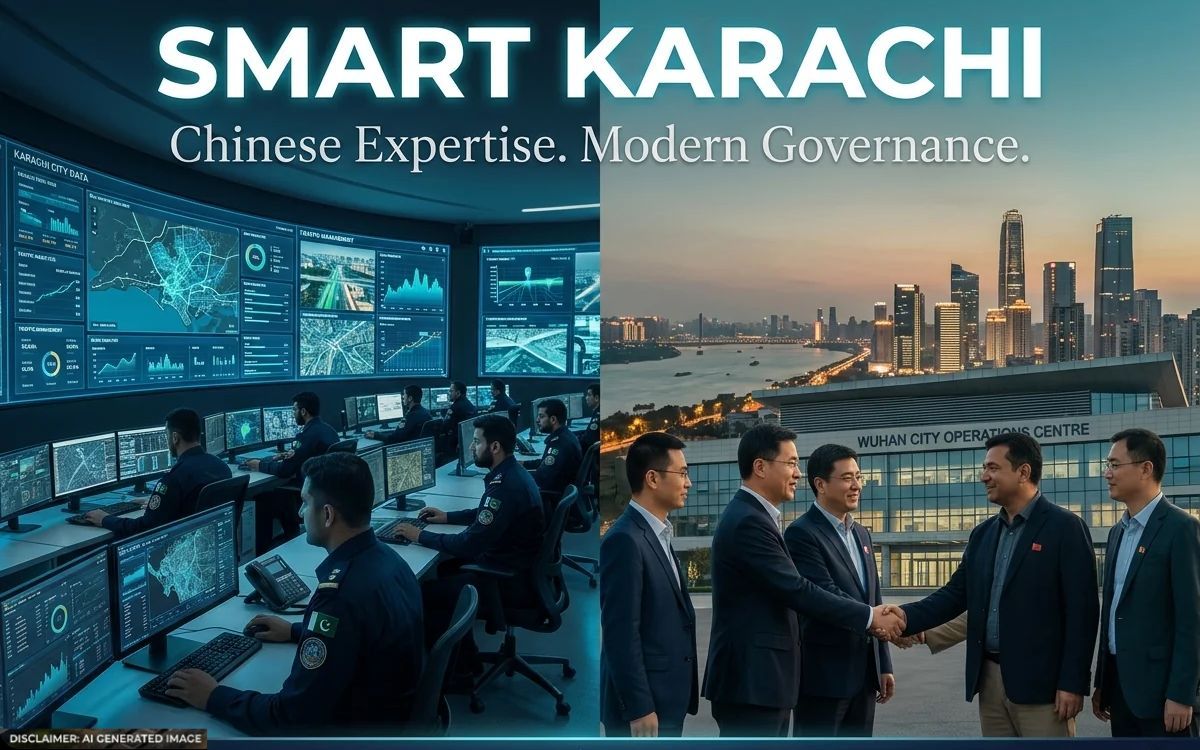
Sindh Chief Minister Syed Murad Ali Shah announced on Wednesday that the provincial government has proposed launching a pilot City Operations and Management Centre in one district of Karachi, aimed at introducing a modern urban management system with Chinese expertise.
Addressing a seminar titled "Understanding China's Governance and Deepening China-Pakistan Cooperation," organised by the Karachi Council on Foreign Relations (KCFR) in collaboration with the Consulate General of China in Karachi at a local hotel, the Chief Minister stated that the initiative is designed to improve coordination among government departments and ensure prompt responses to urban challenges.
Referring to his visit to Wuhan, China, Shah shared that he had observed a modern City Operations and Management Centre where various government departments utilised shared information to address urban issues. He noted that the initial version of the system was developed within one year, while its complete establishment took four years. The Sindh government, he said, would welcome the participation of Chinese municipal experts and engineers in the proposed pilot project. Local officials, engineers, and universities would also be involved, with training teams responsible for operating the system integrated from the outset.
The pilot project's results could determine its expansion to other areas of Karachi, he added, noting that the proposed system would help improve responses to complaints about water accumulation on roads following rainfall, ensure timely restoration of affected roads, and establish clear responsibility among relevant departments.
The Chief Minister remarked that the completion of 75 years of diplomatic relations between Pakistan and China provided an opportunity for both countries to learn from each other's development experiences. He recalled that Shaheed Zulfikar Ali Bhutto had played an important role in laying the foundations of Pakistan-China friendship, which had strengthened through successive generations. He emphasised that bilateral cooperation should be expanded beyond major development projects to initiatives directly benefiting the people.
Highlighting China's development experience, Shah noted that the country had emerged as one of the world's leading industrial and manufacturing economies over the past 35 years. By the end of 2025, China had developed a high-speed railway network spanning more than 50,000 kilometres, connecting cities with employment markets. China's average life expectancy had increased from approximately 68 years in 1990 to 78 years in recent years, which he attributed to decades of economic reforms and investment in infrastructure.
Referring to China's 15th Five-Year Plan for 2026-2030, the Chief Minister stressed that long-term development priorities needed to be incorporated into annual budgets and translated into practical measures. He identified continuity, coordination among institutions, and public-oriented outcomes as important features of China's governance experience that could offer valuable lessons for Sindh. Government policies, he added, should not remain confined to official meetings but deliver tangible benefits to citizens.
On poverty alleviation, Shah noted that China had announced the elimination of rural poverty according to its defined standards by the end of 2020, with around 600 million people moving above the poverty line between 2000 and 2020. He attributed this achievement to targeted interventions, increased agricultural production, industrialisation, employment opportunities, and infrastructure development that connected rural communities with markets. China had also focused on specific villages and households affected by poverty, assigning local authorities the responsibility of identifying deserving families and monitoring their progress. He stated that China's experience in poverty alleviation was worth studying and adapting in Sindh.
Discussing development in Thar, the Chief Minister said Pakistani and Chinese partners had worked together on projects under the China-Pakistan Economic Corridor (CPEC), but the benefits needed to reach local communities. He stressed the importance of technical education and vocational training for young people in Tharparkar, greater participation of local businesses in development projects, and improved access to water and basic facilities for surrounding communities. The needs of local communities must be taken into account during the planning of CPEC projects, he said, adding that the real measure of a development project's success was the improvement it brought to the lives of local people.
Shah also highlighted opportunities to strengthen cooperation between Karachi and Shanghai, which had maintained sister-city relations since 1984. He said municipal institutions in both cities could collaborate in water management, urban transportation, and the improvement of civic facilities through regular institutional engagement. Referring to educational cooperation, he mentioned that discussions had been held at Central China Normal University regarding professional training for teachers from Sindh. Chinese universities could support teacher training, academic exchanges, and joint research programmes involving universities, students, and researchers from both countries.
The Chief Minister also highlighted the potential for cooperation in agriculture, particularly hybrid rice research, improved seed production, and joint research between Sindh Agriculture University and Chinese universities. China's experience could be utilised to increase local seed production, while joint research and the development of improved seeds could benefit farmers in Sindh. Shah stated that Pakistan-China engagement should move beyond occasional visits towards permanent and practical partnerships, suggesting that the proposed Joint Cooperation Council in China's Hubei province could provide a permanent platform for government officials from both countries to maintain regular communication and promote cooperation.
Acting Consul General of China in Karachi Dr Feng Deheng expressed China's pleasure at seeing Pakistan continue to achieve new milestones in its national development and reaffirmed Beijing's support for Pakistan's development and prosperity. Describing Pakistan and China as good friends and all-weather strategic cooperative partners connected by mountains and rivers with a shared future, he said China firmly supported Pakistan in pursuing a development path suited to its national conditions and respected the independent choices of the Pakistani people. China, he said, was ready to share development opportunities and exchange governance experiences with Pakistan.
Feng noted that the 75th anniversary of diplomatic relations between the two countries had been marked by frequent high-level exchanges, fruitful results in practical cooperation, and vibrant people-to-people and cultural exchanges. Referring to recent developments, he said Murad Ali Shah's successful visit to China had opened a new chapter in exchanges and cooperation between Sindh and China's Hubei province and Shanghai. He also highlighted the official launch of the China-Pakistan Information Corridor, saying it would provide a more efficient communication platform to promote exchanges, mutual learning, and common development.
He further shared that a Pakistani astronaut would soon participate in the Shenzhou-24 manned spaceflight mission, becoming the first foreign astronaut to step into the Chinese space station. Looking ahead, Feng said both countries should use the 75th anniversary of diplomatic relations as a new starting point to carry forward their all-weather friendship, deepen comprehensive cooperation, promote mutual learning among civilisations, and build an upgraded CPEC 2.0 with high quality. These efforts, he added, would accelerate the building of an even closer China-Pakistan community with a shared future in the new era and create a brighter future for the people of both countries. KCFR Chairperson Nadira Panjwani also addressed the gathering on the occasion.