ML-1 Railway: Pakistan's Emerging Connectivity Link Between CPEC 2.0 and CAREC
The Karachi-Peshawar railway stands at the intersection of Pakistan's CPEC 2.0 ambitions and the broader CAREC transport network, positioning Main Line-1 (ML-1) as a potential cornerstone of regional connectivity architecture. Federal Minister for Planning, Development and Special Initiatives Ahsan Iqbal presented Pakistan's modernisation plan for ML-1 at a Development Partners Dialogue in Ulaanbaatar on September 28, framing the 1,726-km railway as critical to expanding trade, freight capacity, and regional connectivity. The dialogue, titled "Advancing Trade, Tourism and Regional Connectivity," was held during his official visit to Mongolia for the CAREC programme, where he also met with the CAREC Institute and a delegation from Uzbekistan.
The significance of the presentation extends well beyond the immediate railway project. ML-1 operates within a wider regional connectivity geography that encompasses the CAREC network and intersects with the connectivity ambitions of CPEC Phase II. According to the Minister, ML-1 currently carries 76 percent of passenger and 98 percent of freight traffic despite significant infrastructure constraints. The planned upgrade would raise capacity from 34 to 120 train pairs, increase passenger speeds to 160 kmph and freight speeds from 30 to 80 kmph, and reduce Karachi-Rohri travel time from approximately eight hours to roughly four and a half hours. Importantly, the government is presenting Karachi-Rohri not as a standalone intervention but as the first step toward modernising the complete Karachi-Peshawar corridor. Freight demand is projected at around 21 million tonnes annually by 2035. The Asian Development Bank (ADB) describes the roughly 480-km Karachi-Rohri section as the link between the main port and the national network, noting that a road-dominated system leaves logistics costs at nearly 15 percent of GDP.
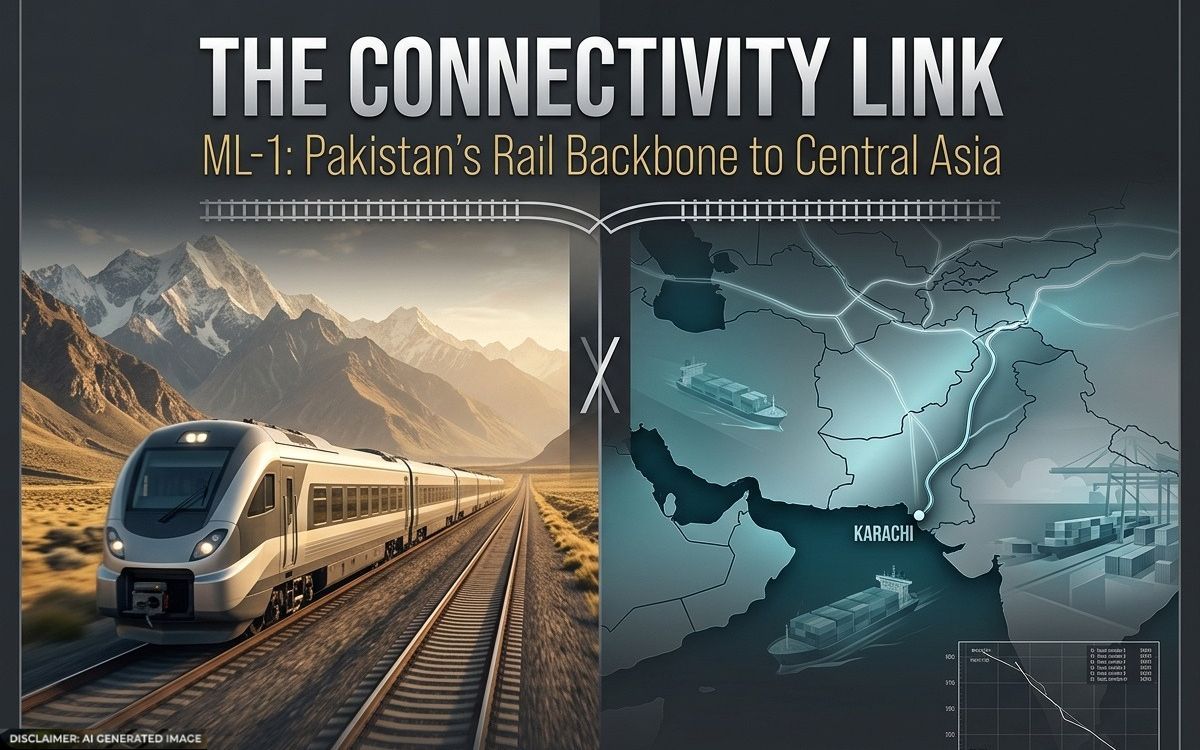
ML-1's significance therefore extends beyond faster domestic services. If financing is secured, implementation progresses, and the necessary institutional and cross-border links are developed, the railway could become an important piece of Pakistan's wider connectivity architecture, linking its domestic logistics network with the CAREC system and complementing the Regional Connectivity agenda of CPEC 2.0. The route is not yet an established Central Asian trade corridor; its significance lies in the infrastructure and institutional choices that could make such connectivity commercially viable.
CAREC Corridor 5, officially titled East Asia-Middle East and South Asia, connects Central Asia and East Asia to South Asia, offering potential routes to Karachi's seaports for landlocked countries. A 2021 CAREC railway assessment names Corridors 5 and 6 as relevant to Pakistan's railways and identifies Subcorridor 501, from Kashgar, as following ML-1 through Havelian, Islamabad, and Lahore to Karachi. It calls Havelian-Kashgar a missing link, noting that an upgrade would ease ML-1's capacity bottlenecks. The regional line exists as a strategic framework, but several of its physical links remain incomplete. ML-1 can therefore be viewed as a potential Pakistan rail backbone within this wider architecture rather than as a fully operational Central Asian trade corridor.
The CPEC 2.0 connection emerges from Pakistan's broader regional connectivity agenda. The CPEC Secretariat describes Phase II as driven by five corridors: Growth, Innovation, Green Development, Livelihood, and Regional Connectivity, and identifies ML-1 among its flagship connectivity projects. The 2025-2029 Action Plan covers industrial cooperation, special economic zones, agriculture, maritime development, mining, and flagship connectivity projects including ML-1, the Karakoram Highway realignment, and Gwadar. ML-1 appears on the official CPEC project list, yet its Karachi-Rohri section is now being advanced with ADB leading the financing effort. The overlap is physical: one railway line that both frameworks could rely on. The 2025-2029 Action Plan calls for a practical financing and implementation plan for ML-1 to support the high-quality development of CPEC connectivity, while also calling for Gwadar to be leveraged for trade with Afghanistan, Central Asia, and beyond.
Meeting Uzbekistan's Deputy Minister of Investment, Industry and Trade, Ilzat Kasimov, Mr. Iqbal said the proposed Uzbekistan-Afghanistan-Pakistan (UAP) railway could link Central Asian markets with Pakistani ports. He urged a faster feasibility study, identification of financing, and a joint financing mechanism. The Ministry stated that the proposed UAP railway should ultimately be conceived as an integrated economic corridor linking railways, highways, logistics, ports, and industrial centres. The potential chain runs from ML-1 through the national network to Karachi and, if cross-border links are built, toward Central Asia. The proposition remains conditional.
Financing remains central to the implementation challenge. Mr. Iqbal described Karachi-Rohri as the most advanced section, estimating its cost at approximately $2.5 billion, and said ADB was leading the financing effort with other development partners engaged. However, ADB's current project documentation classifies its Karachi-Rohri facility as "proposed," with project-readiness financing approved in 2025 and follow-on financing under consideration. The distinction is important: preparations and financing work are advancing, but the ADB facility should not yet be described as an approved full-project loan.
Money is not the only test. Technical and preparatory work is already moving forward. ADB's September 2026 market-engagement process covers the proposed Karachi-Rohri upgrade, including climate-resilient railway infrastructure, signalling modernisation, operations, and institutional capacity-building. CAREC's strategy notes that infrastructure progress does not always translate into better trade outcomes, citing border delays. The 2021 assessment flagged rail pricing, port-terminal inefficiency, and unreliable service, warning that the upgraded line might attract less traffic than hoped without commercial reform. ADB likewise states that the upgrade must be complemented by institutional and financial reforms.
ML-1's significance therefore extends beyond faster domestic services. If financing is secured, implementation progresses, and the necessary institutional and cross-border links are developed, the railway could become an important piece of Pakistan's wider connectivity architecture, linking its domestic logistics network with the CAREC system and complementing the Regional Connectivity agenda of CPEC 2.0. The route is not yet an established Central Asian trade corridor. Its significance lies in the infrastructure and institutional choices that could make such connectivity commercially viable.