$440 Million Pharma Agreements Mark New Milestone in Pakistan-China Partnership
Prime Minister Shehbaz Sharif has welcomed the signing of nine investment agreements worth approximately $440 million between Pakistani and Chinese private enterprises in the pharmaceutical sector, describing the development as a significant milestone in strengthening bilateral economic ties and advancing the second phase of the China-Pakistan Economic Corridor (CPEC 2.0).
Speaking at the Pakistan-China Pharmaceutical Business-to-Business Conference in Islamabad, the Prime Minister said the agreements reflect growing confidence in Pakistan's investment potential and are expected to translate into practical projects that will expand pharmaceutical manufacturing, vaccine production, research and development, and healthcare innovation across the country.
He expressed optimism that the new partnerships would help Pakistan emerge as a regional center for the production and export of life-saving medicines and pharmaceutical products, serving both domestic healthcare needs and neighboring markets.
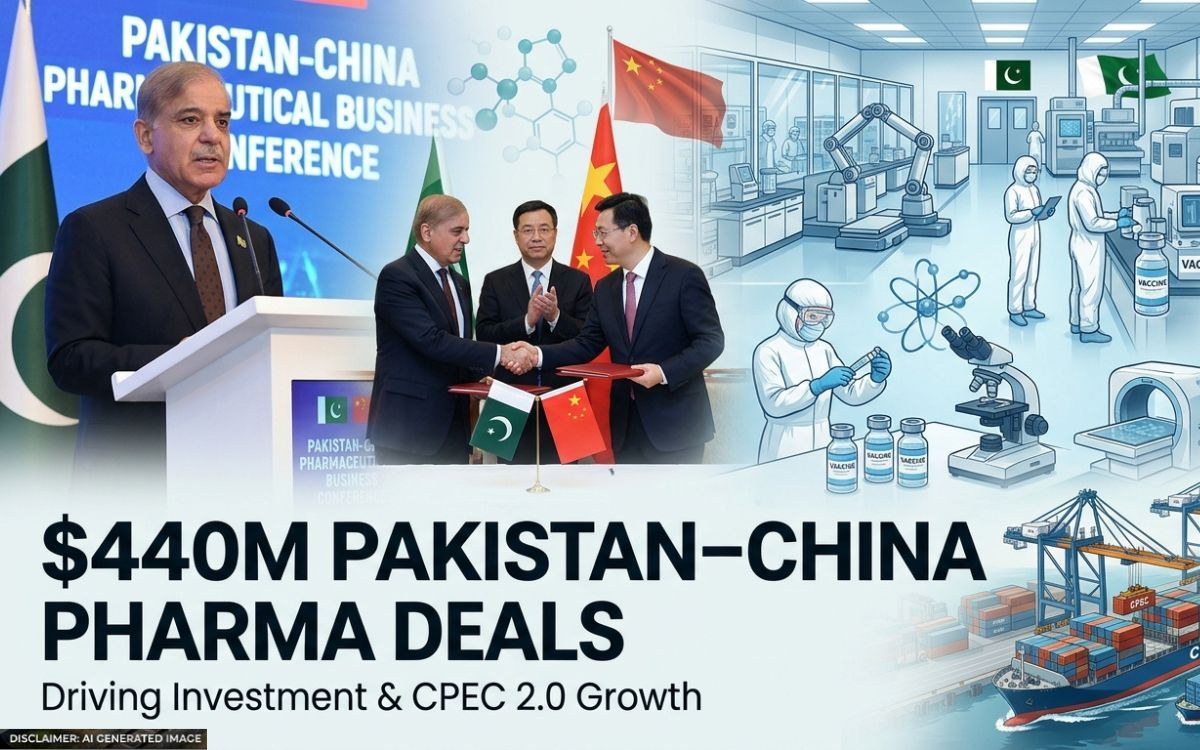
The Prime Minister noted that China has remained a steadfast partner of Pakistan through various stages of economic development, highlighting that more than $30 billion has already been invested under the first phase of CPEC. He said the latest pharmaceutical agreements represent another important step in broadening economic cooperation and creating new opportunities under CPEC 2.0, with greater emphasis on industrial development, technology transfer and private-sector collaboration.
Shehbaz Sharif also reaffirmed Pakistan's commitment to promoting regional peace and stability, stating that the country played a constructive diplomatic role during recent regional developments with the support of friendly nations, particularly China. He acknowledged the contributions of President Xi Jinping, Premier Li Qiang, and other Chinese leaders for their continued support, while also appreciating the efforts of Field Marshal Syed Asim Munir and Deputy Prime Minister Ishaq Dar in advancing diplomatic engagement.
Reassuring Chinese businesses and investors, the Prime Minister emphasized that ensuring the safety and security of Chinese nationals working in Pakistan remains one of the government's highest priorities. He said comprehensive security measures continue to be implemented to provide a safe and stable environment for investment and long-term economic cooperation.
Addressing the conference, Chinese Ambassador Jiang Zaidong highlighted Pakistan's large and expanding population as a key factor driving demand for healthcare and pharmaceutical products. He described Pakistan's pharmaceutical industry as an attractive destination for investment and noted that the Chinese Embassy has actively facilitated business partnerships by connecting enterprises from both countries.
The conference underscored the growing momentum in Pakistan-China economic relations, with the latest pharmaceutical agreements expected to support industrial modernization, strengthen healthcare manufacturing, encourage technology transfer and create new opportunities for exports, investment and sustainable economic growth under the evolving framework of CPEC 2.0.