Falcon Oils Refinery Gets CPEC Nod for Dhabeji Mega-Project
Pakistan's proposed $3.5 billion Falcon Oils Refinery and Storage Complex at Dhabeji in District Thatta has successfully cleared a critical institutional milestone after receiving formal endorsement from the China-Pakistan Economic Corridor (CPEC) Secretariat. The Secretariat has officially directed the Board of Investment (BoI) to present the project before the Joint Working Group on Industrial Cooperation, marking a significant step forward in the CPEC approval pipeline.
This development positions the Falcon Oils project as one of Pakistan's largest privately sponsored industrial investments in recent memory, signaling a substantial push toward channeling private-sector capital into the nation's petroleum and energy infrastructure. The project's progression underscores the growing confidence in Pakistan's investment climate under the CPEC Phase-II framework.
According to an Office Memorandum issued by the CPEC Secretariat at the Ministry of Planning, Development and Special Initiatives on August 24, 2026, Falcon Oils (Pvt) Limited has proposed a state-of-the-art 100,000 barrels-per-day deep-conversion refinery. The complex will also feature a major petroleum storage facility and a captive power generation unit, creating a comprehensive energy hub in Sindh's coastal industrial belt.
The memorandum, numbered CPECS/IC(14)/601/2026, formally supports the project's inclusion within the CPEC framework as a business-to-business initiative. This classification aligns seamlessly with the government's stated vision for CPEC Phase-II, which prioritizes greater private-sector participation and reduced government intervention in commercially viable ventures.
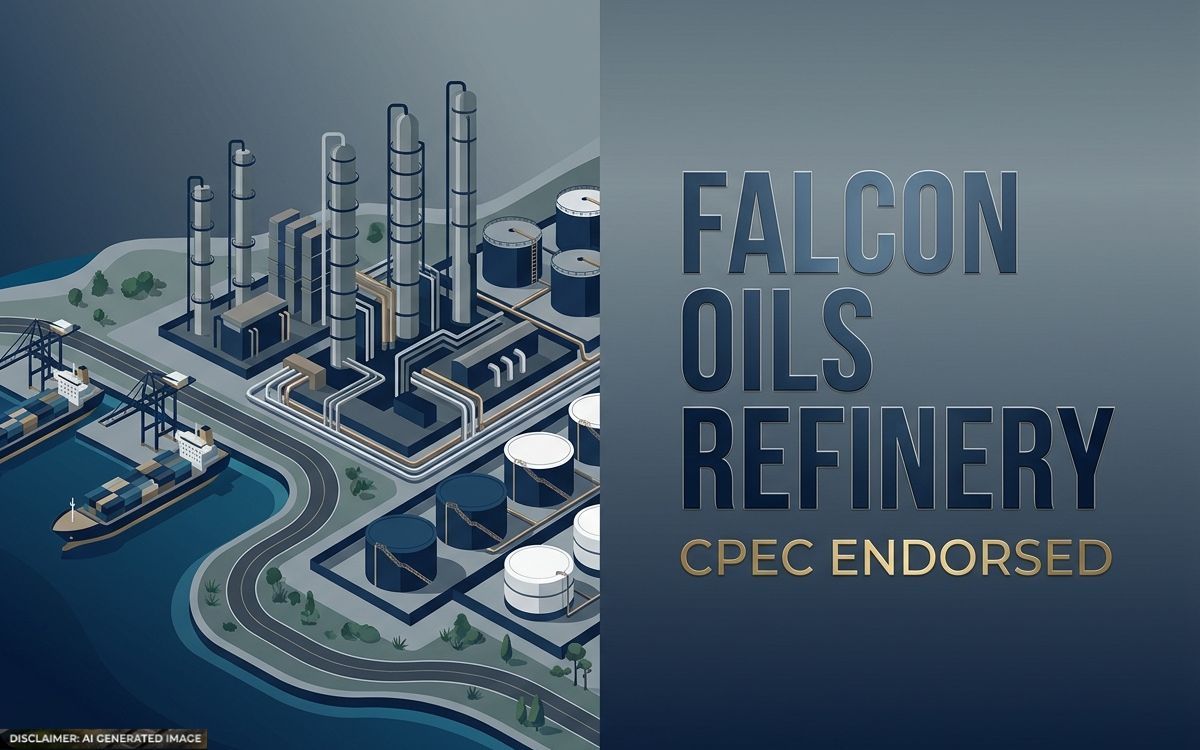
The proposed complex is expected to include an impressive 4 million tonnes of crude and petroleum-product storage capacity, alongside a 50MW captive power plant designed to ensure operational self-sufficiency. The refinery itself is planned to produce Euro-V-compliant fuels—a specification that could substantially strengthen Pakistan's domestic refining capacity while simultaneously reducing the country's reliance on expensive imported finished petroleum products.
The project has already secured established Chinese technical and engineering partnerships, further solidifying its viability. The feasibility study has been prepared by Xinjiang Petroleum Engineering Design Co Ltd, while Engineering, Procurement, and Construction (EPC) arrangements have been finalized with CEEC-GEDI and CGGC—both prominent Chinese engineering firms with extensive experience in large-scale energy infrastructure.
The strategic location at Dhabeji, situated in Sindh's coastal industrial corridor and in close proximity to Karachi's port facilities and crude-import infrastructure, provides the refinery with a distinct logistical advantage. This positioning is ideal for a facility designed around imported crude oil and domestic petroleum-product distribution networks.
For Pakistan, the Falcon Oils project carries far-reaching implications for national energy security. By augmenting domestic deep-conversion refining capacity, the complex is expected to help shift a portion of the petroleum import bill away from finished products toward crude oil—a strategic move that could yield significant foreign exchange savings. The substantial storage capacity addition will also enhance the country's petroleum buffer stocks, providing greater resilience against supply disruptions.
Falcon Oils has confirmed that the refinery and storage complex will be developed and financed entirely by private sponsors on a fully non-recourse basis. Crucially, the project carries no sovereign guarantee and offers no financial or other recourse to the Government of Pakistan, insulating the national exchequer from potential liabilities.
Beyond energy security, the project is expected to generate substantial employment opportunities during both the construction and operational phases. Permanent jobs in Thatta district will provide a significant economic boost to the Dhabeji area, potentially transforming it into a major industrial anchor for the region.
The development was confirmed by Sirhaan Ahmed Khan, CEO of Falcon Oils, who described the CPEC Secretariat's endorsement as a pivotal step toward advancing the project through the formal CPEC industrial-cooperation mechanism. His remarks underscore the private sector's growing enthusiasm for CPEC-linked opportunities.
With the Board of Investment now tasked with presenting the proposal to the Joint Working Group, the Falcon Oils project enters a potentially decisive stage. The outcome of this review will determine how the proposed refinery progresses within Pakistan's broader CPEC industrialisation strategy.
If implemented as planned, the 100,000-barrel-per-day facility would add a transformative new refining and storage asset to Pakistan's energy infrastructure. More broadly, it would demonstrate the viability of privately financed, non-recourse projects in the next phase of Pakistan-China economic cooperation—setting a powerful precedent for future industrial collaborations under the CPEC umbrella.