CPEC Boosts Pakistan’s Agriculture With 258 Chinese Machines
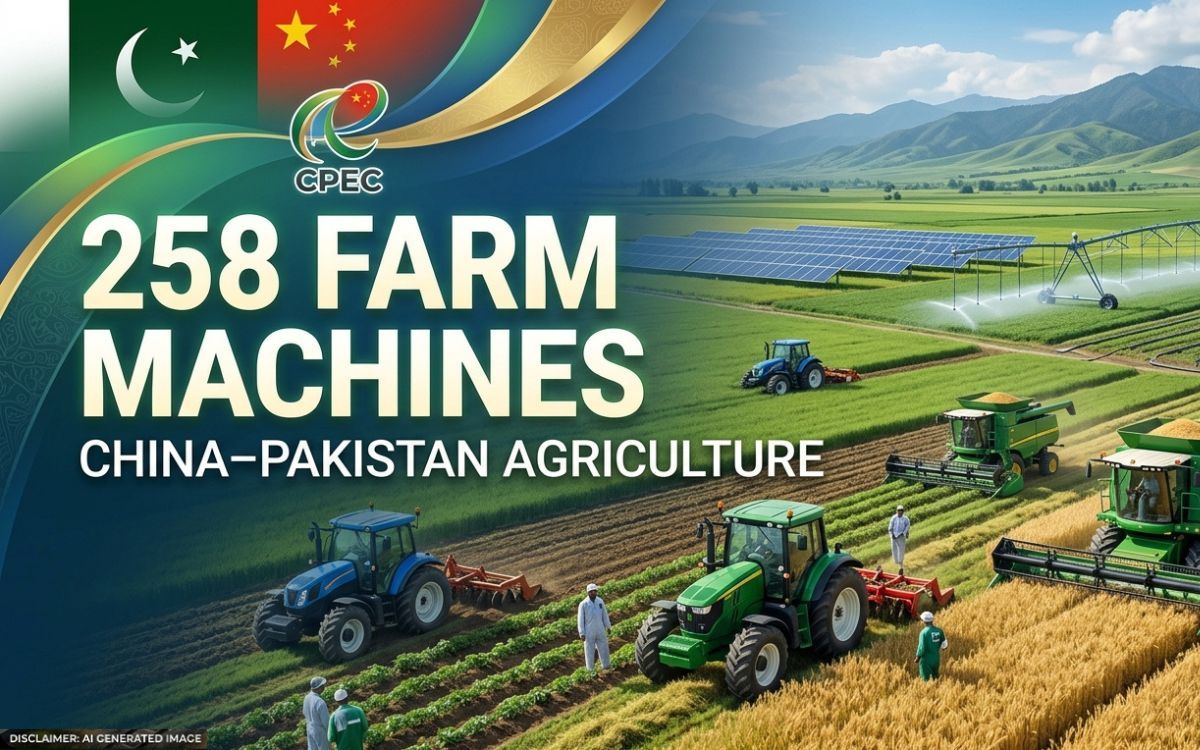
Pakistan has received 258 advanced agricultural machines and irrigation systems from China under CPEC agricultural cooperation, supporting efforts to modernise farming, improve productivity and promote climate-resilient agriculture.
The machinery was received and assembled by the Agricultural Engineering Institute of the Pakistan Agricultural Research Council (PARC) at the National Agricultural Research Centre (NARC), Islamabad. The equipment will be distributed among PARC and provincial governments for technology demonstration and wider adoption.
The package includes nine categories of machinery, comprising 40 tractors, 20 rotary tillers, 30 rotary tillage fertilizer drills, 40 crawler-type rice-wheat combine harvesters, eight corn harvesters, 40 inter-tillage weeders, 40 trimmers, 20 hose-reel irrigation systems and 20 photovoltaic water-pumping systems.
Of the 258 units, 75 will be allocated to Punjab, 45 to Sindh, 38 to Khyber Pakhtunkhwa, 36 to Balochistan and 64 to PARC.
The machinery forms part of the Prime Minister’s Agriculture Modernization Initiative, which aims to transform Pakistan’s agriculture into a technology-driven, climate-resilient and export-oriented sector. The programme focuses on improving productivity, strengthening food security, promoting value addition and increasing the competitiveness of the country’s agri-food system through modern machinery, improved seeds, biotechnology, precision agriculture and climate-smart technologies.
The initiative is supported by the National Agricultural Biotechnology Policy 2026 and National Seed Policy 2026, which provide frameworks for improved crop varieties, biotechnology research, a stronger seed system and greater access to high-yielding and climate-resilient varieties.
A major component is cooperation between PARC and the Chinese Academy of Agricultural Sciences (CAAS). The federal government approved the restructuring of PARC along CAAS lines in March 2026, with five Centres of Excellence planned at NARC covering crop genomics, livestock improvement, climate-smart land and water solutions, artificial intelligence in agri-food systems, and food processing and value addition.
A Centre of Excellence for Advanced Agricultural Mechanization and Digital Agriculture is also planned in collaboration with CAAS. It is expected to become a national hub for precision agriculture, artificial intelligence, robotics, IoT, drones and climate-smart machinery.
The government is also working on a National Agricultural Mechanization Policy, local machinery manufacturing, testing and certification systems, Custom Hiring Centres, post-harvest mechanisation and advanced technical training.
Meanwhile, under a programme to train 1,000 Pakistani agricultural graduates in China, 885 graduates have completed specialised training, while the remaining 115 are expected to depart shortly. Training covers areas including farm mechanisation, high-efficiency irrigation, drones, AI, IoT, crop breeding, livestock, aquaculture and seed technologies.
The trained graduates are expected to transfer modern farming knowledge to farmers, researchers, extension services and educational institutions, helping accelerate the adoption of precision agriculture, mechanisation, water-efficient technologies and value-added processing across Pakistan.