Khunjerab Emerges as Key Trade Gateway with Rs14.93 Billion Revenue
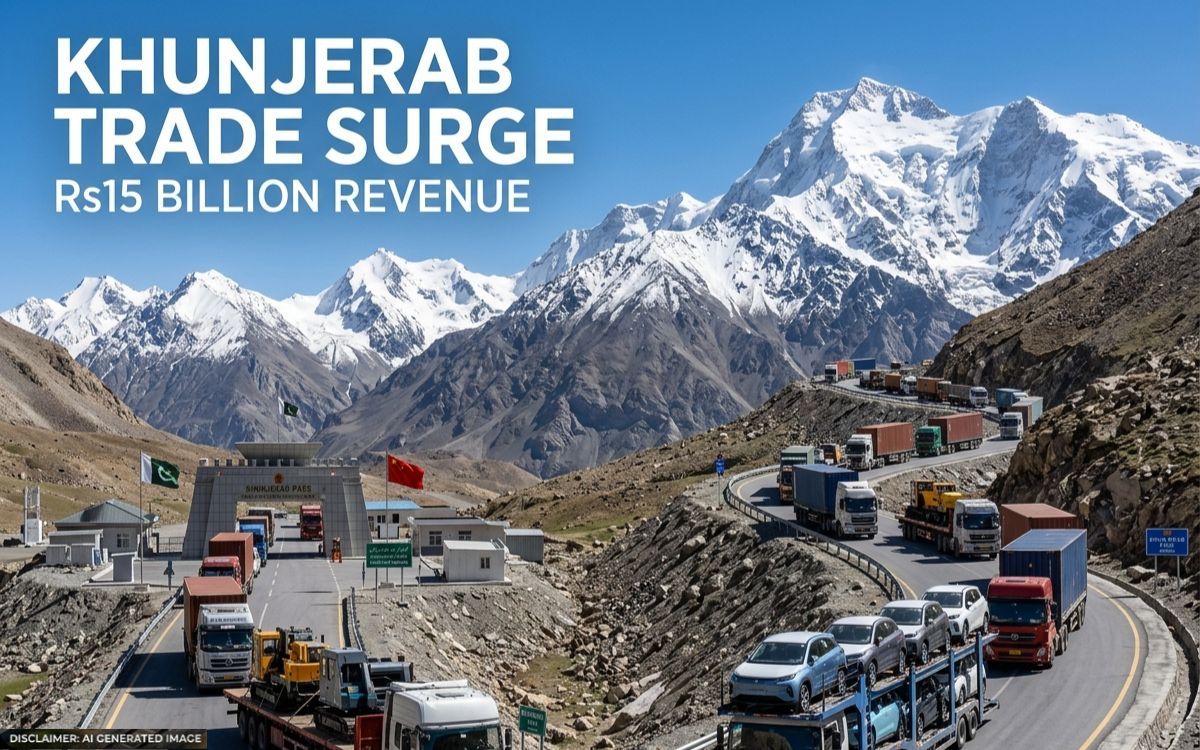
Pakistan’s northern trade gateway has recorded a major surge in activity, with Customs authorities collecting nearly Rs15 billion in revenue from imports through the Khunjerab Pass during FY2025-26. Meanwhile, exports worth around Rs2.8 billion travelled through the same route to China and Central Asian markets.
The latest figures underline the growing importance of the Khunjerab-Sost corridor as Pakistan expands overland trade with China and seeks to strengthen the northern arm of the China-Pakistan Economic Corridor (CPEC).
Customs revenue through the route reached approximately Rs14.93 billion, rising from Rs13.67 billion a year earlier and setting a new record. At prevailing exchange rates, the latest collection is equivalent to roughly $53–55 million.
The increase reflects higher movement of machinery, electric vehicles, consumer products and other goods from China through the mountainous border crossing. Some cargo that traditionally travelled through Karachi is increasingly using the northern corridor as an alternative supply route.
While imports have generated a substantial revenue boost, exports through Khunjerab remained around Rs2.8 billion, highlighting the continuing imbalance in Pakistan’s trade with China.
The TIR transit system is helping Pakistani products, including cherries, fruits, gemstones, handicrafts, rice, garments and leather goods, reach Chinese and Central Asian markets. The expanding trade flow is also creating opportunities for transporters, customs agents, traders and other service providers operating around Sost Dry Port.
However, Pakistan’s exports remain modest compared with its overall trade with China. Bilateral trade has crossed $25 billion in recent years, with Pakistani exports generally ranging between $2.5 billion and $2.8 billion, while imports from China have reached approximately $16–20 billion or more in recent fiscal data. This imbalance continues to contribute to Pakistan’s substantial trade deficit.
The rising cargo volume through Khunjerab is also reshaping the country’s logistics landscape. Electric vehicles, specialised machinery and other products are increasingly able to use the northern land route, providing an alternative to conventional maritime supply chains through Pakistan’s southern ports.
The expansion of TIR-based transit has simultaneously strengthened the prospect of Pakistan serving as a land bridge towards Central Asia. For CPEC, this development carries additional significance as the economic corridor moves beyond its initial focus on power generation and physical infrastructure.
Since its launch around 2015, CPEC has produced approximately $25–26 billion in completed projects, including energy plants, roads, motorways, transmission lines, Gwadar-related infrastructure and social-sector initiatives. The next phase, commonly referred to as CPEC 2.0, is placing greater emphasis on industrialisation, Special Economic Zones, agriculture, mining, artificial intelligence, technology, digital development, green projects, business-to-business investment and export growth.
Against this backdrop, a stronger Khunjerab trade route could become an important northern logistics link connecting Pakistani producers with Chinese and Central Asian markets. Authorities are also increasing enforcement against illicit trade along the route.
Recent operations led to the seizure of smartphones, wine and pork worth approximately Rs158 million. The confiscated goods were subsequently subjected to legal disposal and auction procedures. Officials view such enforcement as part of efforts to bring more trade into the formal economy and protect legitimate businesses from competition created by smuggled goods.
The developments at Khunjerab come amid the broader Pakistan-China relationship, which Islamabad and Beijing describe as an “all-weather strategic cooperative partnership” and frequently refer to as an “iron brothers” relationship.
China remains one of Pakistan’s major foreign investment partners and a leading defence supplier. Bilateral cooperation also includes joint production programmes such as the JF-17, alongside coordination through international forums including the Shanghai Cooperation Organisation and the United Nations.