CPEC 2.0 to Focus on Industrialisation, Exports and B2B Cooperation
Pakistan is seeking to leverage the second phase of the China-Pakistan Economic Corridor (CPEC 2.0) to accelerate industrialisation, increase exports and turn productive sectors into engines of sustainable economic growth.
Planning Minister Ahsan Iqbal made the remarks during consultations with a high-level Chinese delegation led by Sun Dongsheng, Senior Advisor, Economic Affairs Press, at the Ministry of Planning, Development and Special Initiatives. The meeting focused on expanding business-to-business (B2B) and industrial cooperation under CPEC 2.0.
The two sides discussed stronger policy coordination, improved implementation mechanisms and practical cooperation across key economic sectors. Iqbal also briefed the delegation on the government’s Uraan Pakistan economic transformation agenda and called for closer engagement with Chinese institutions to benefit from China’s expertise in innovation, automation and robotics as Pakistan prepares for Industry 4.0 and 5.0.
The minister identified Pakistan’s limited export base as a major economic challenge, noting that weak export performance has repeatedly affected the sustainability of economic growth. He said the government’s priority was to transform the country’s productive sectors into globally competitive and export-oriented industries.
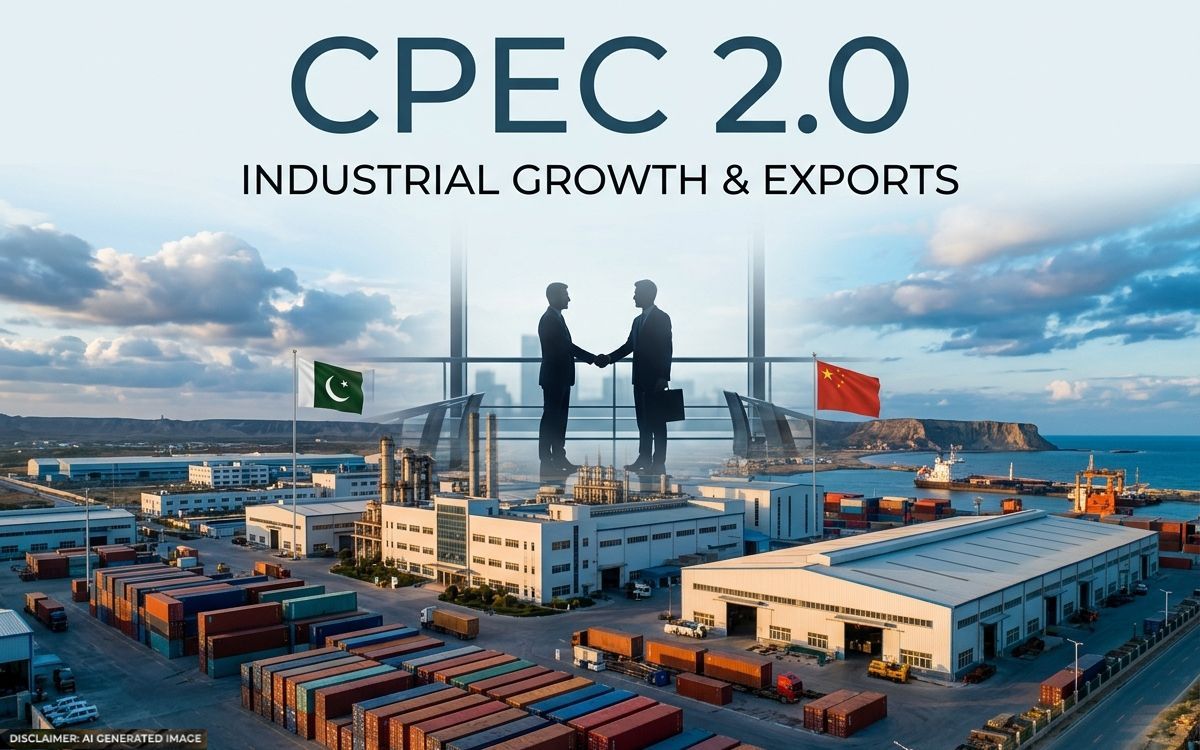
“China helped Pakistan overcome its energy deficit under CPEC 1.0, and now we hope CPEC 2.0 will help us overcome our export deficit,” he said.
Iqbal also highlighted the need to improve Pakistani products’ access to the Chinese market. While China imports nearly $2.6 trillion worth of goods annually, Pakistan’s exports to China remain around $3 billion, highlighting significant room for expansion.
CPEC 2.0 is increasingly centred on B2B cooperation, with Pakistani and Chinese enterprises recently entering regional agreements covering industrial, agricultural and mining sectors. The minister expressed hope that stronger business partnerships would contribute to the modernisation of Pakistan’s agriculture and industrial sectors.
Sun Dongsheng welcomed the discussions and reaffirmed the importance of the longstanding China-Pakistan relationship. He highlighted the achievements of CPEC Phase I and stressed the need to deepen cooperation in industry and agriculture, strengthen productive capacity, support small and medium-sized manufacturing enterprises, and expand enterprise-to-enterprise partnerships.
The consultations highlighted the evolving focus of CPEC 2.0, moving from infrastructure toward industrialisation, connectivity toward competitiveness, and investment toward productivity. The new phase also places greater emphasis on business-to-business partnerships alongside traditional government-to-government cooperation.
Pakistani and Chinese officials also discussed the alignment between the five corridors of CPEC 2.0 and Pakistan’s Uraan Pakistan 5Es framework, with a focus on enterprise development, technology, innovation, employment, skills, exports, investment and shared prosperity.
The Chinese delegation was further briefed on the progress of CPEC Phase I and the priorities of its second phase, including industrial cooperation, agriculture, science and technology, information technology, mining and minerals, Gwadar development and enhanced B2B engagement.
Both sides expressed readiness to deepen cooperation and align development priorities, positioning CPEC 2.0 as a potential driver of industrial productivity, high-quality economic growth, increased exports and shared prosperity.