Vitol Expands Marine Fuel Operations as Gwadar Eyes Regional Shipping Market
Gwadar Port is rapidly strengthening its position as a regional maritime hub after Dutch energy trader Vitol launched commercial marine fuel operations at the deep-sea port. The move is expected to enhance Gwadar’s role as an alternative bunkering destination for international shipping lines, with industry sources indicating that up to 30 bunker fuel deliveries could be completed during the coming weeks.
Traditionally, commercial ship refuelling in the region has been dominated by ports such as Fujairah and Khor Fakkan in the United Arab Emirates. However, evolving regional dynamics and growing demand for alternative fuel supply locations have created new opportunities for Gwadar to expand its maritime services. Vitol Bunkers (S) Pte. Ltd., the marine fuels division of the Netherlands-based Vitol Group, has begun operations at the port to meet increasing demand from shipping companies seeking greater operational flexibility.
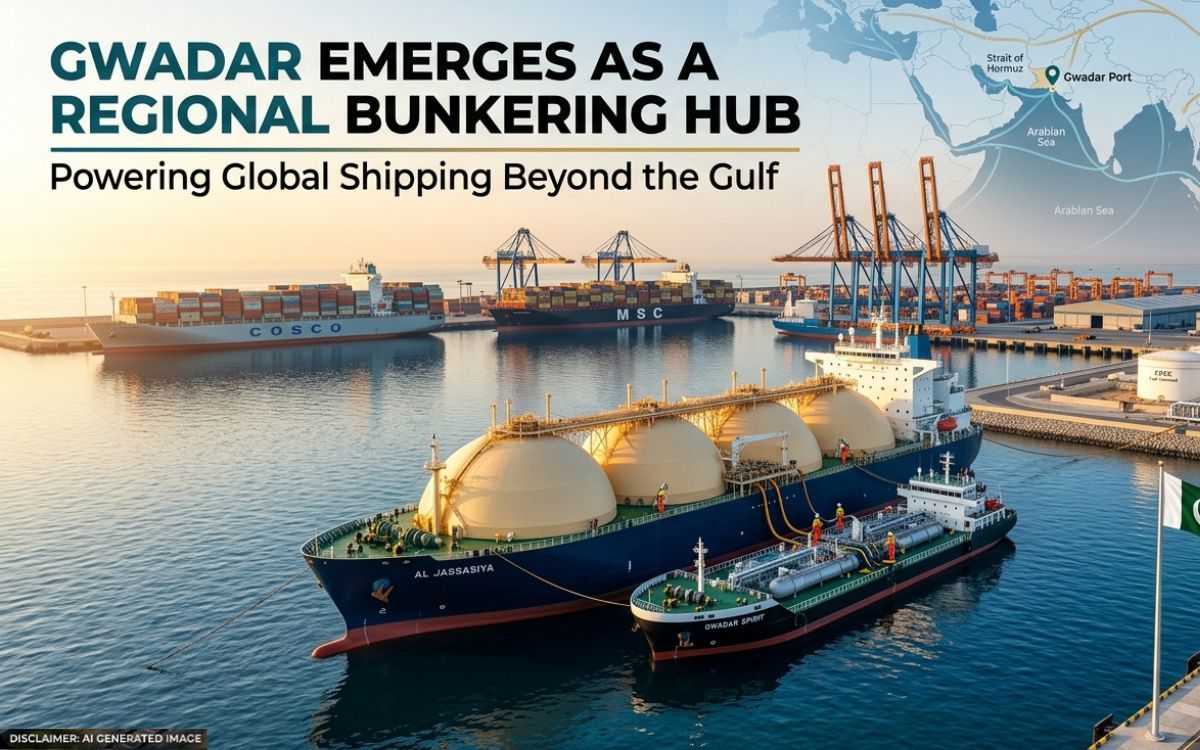
According to industry sources, the initiative follows rising concerns over shipping routes through the Strait of Hormuz, encouraging vessel operators to diversify their refuelling options. Vitol's Global Strategic Business Manager, Ammar Hussaini, noted that Gwadar Port has benefited from substantial infrastructure investment, expressing confidence in expanding the company's regional service offering from the strategically located port.
The company recently completed its first marine fuel supply at Gwadar by delivering 2,500 tonnes of Very Low Sulphur Fuel Oil (VLSFO) to a liquefied natural gas (LNG) carrier. Industry officials further revealed that Vitol has already secured additional supply agreements with international clients and expects shipping activity at Gwadar to increase steadily over the coming months. Initially, fuel will be transported from Karachi before permanent storage facilities are established at the port, where current operational capacity can support up to 50,000 tonnes of bunker fuel per month using two dedicated bunker barges.
Maritime experts describe the development as a significant milestone for Pakistan's blue economy and maritime sector. Pakistan Ship's Agents Association Chairman Muhammad A. Rajpar said Gwadar possesses several competitive advantages, including lower port charges and a strategic location outside the Strait of Hormuz, making it an attractive option for international vessels. Former Gwadar Port Authority Chairman Dostain Jamaldini also highlighted the port's geographical advantage for ships travelling between the Red Sea, the Indian Ocean, China and the Pacific region. He added that future collaboration with Iran's Chabahar Port under the existing sister-port agreement could further strengthen regional bunkering services and create new revenue opportunities. As commercial bunkering operations expand, Gwadar is expected to reinforce its position under the China-Pakistan Economic Corridor (CPEC) as a leading gateway for trade, logistics, marine services and international shipping.