Gwadar Emerges as Strategic Trade Hub Through the Gabd Corridor
The launch of the Gabd–Rimdan–Gwadar/Karachi Corridor marks a significant milestone in regional connectivity, offering Central Asian nations a practical and secure trade route to the Arabian Sea. As geopolitical tensions continue to disrupt traditional transit networks through Afghanistan, the newly operational corridor provides Uzbekistan and neighboring countries with a reliable alternative that strengthens economic integration across South Asia, the Middle East, and Central Asia.
For decades, landlocked Central Asian economies have sought dependable access to warm-water seaports to diversify trade and reduce logistical challenges. Uzbekistan, home to more than 37 million people, has long viewed maritime connectivity as essential for expanding exports and strengthening supply chains. With the Gabd Corridor becoming operational in early 2026, that objective has moved significantly closer to reality.
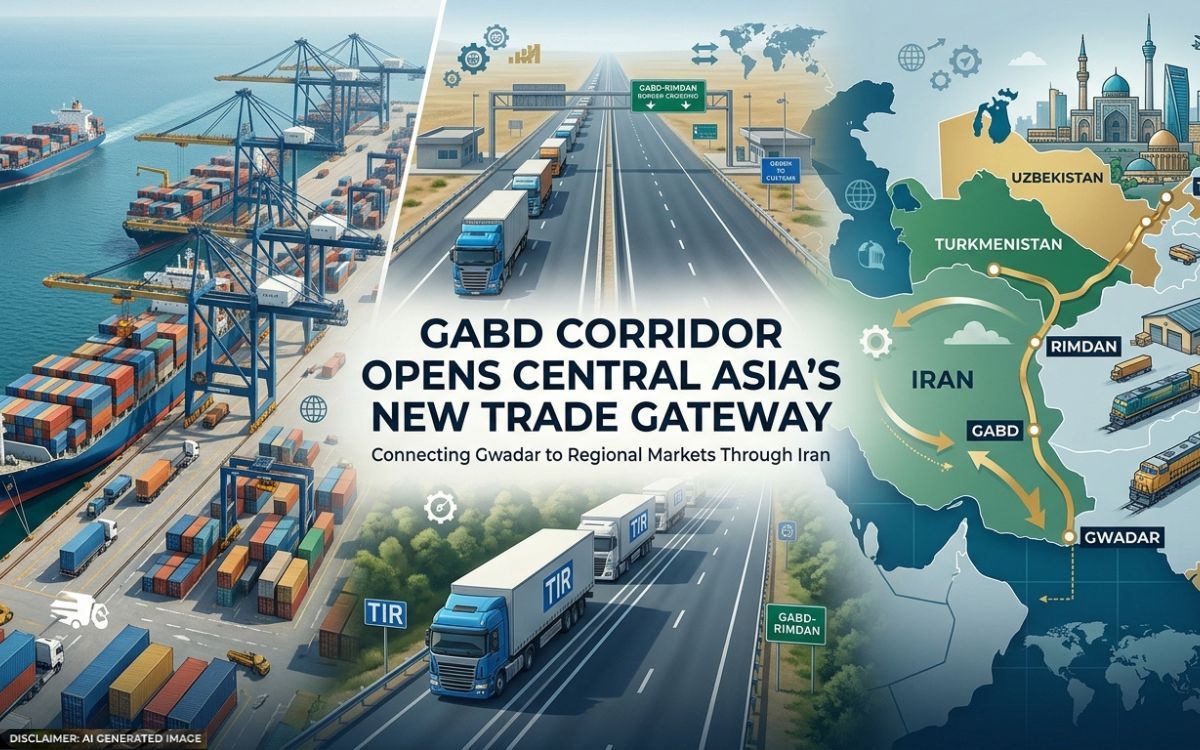
The corridor begins at Pakistan’s ports of Gwadar and Karachi before extending overland to the Gabd Border Terminal near Gwadar. From there, cargo crosses into Iran through the Rimdan border terminal in Sistan-Baluchistan Province and continues north via Birjand to Ashgabat in Turkmenistan before reaching Tashkent, Uzbekistan. By completely bypassing Afghanistan, the route provides traders with a more stable, secure, and efficient logistics network.
Constructed in 2024 and activated for international TIR operations by Pakistan’s National Logistics Corporation, the Gabd Border Terminal has become a key component of Pakistan’s regional connectivity strategy. Under the TIR (Transports Internationaux Routiers) system, cargo trucks are sealed at their point of departure and remain unopened until reaching their final destination. This internationally recognized procedure minimizes customs delays, enhances cargo security, and significantly reduces opportunities for unnecessary inspections and corruption.
The strategic importance of the corridor has grown as border tensions between Pakistan and Afghanistan have repeatedly disrupted overland trade since late 2024. These disruptions have increased transportation costs, extended delivery times, and created uncertainty for exporters serving Central Asian markets. The Gabd Corridor addresses these challenges by offering a dependable alternative that is shorter, safer, and more predictable than existing routes.
Compared with northern transit corridors passing through Kazakhstan and Russia, the Gabd route offers notable logistical advantages. It is expected to reduce transport costs by approximately 15 to 25 percent while cutting transit times from an average of 35–45 days to nearly 15–20 days. These efficiencies could substantially improve the competitiveness of Central Asian exports while lowering import costs for regional industries.
Uzbekistan stands to benefit across multiple sectors. The country’s exports—including textiles, cotton, fresh fruits, copper, and gold—can reach international markets more quickly through Pakistani ports, while imports of machinery, industrial equipment, and consumer goods become more cost-effective. Faster transit is particularly valuable for agricultural exports, enabling perishable products such as fruits and meat to access Gulf markets with greater freshness and reduced spoilage.
Pakistan also gains significant strategic advantages from the corridor. The initiative reinforces Islamabad’s broader vision of transforming the country into a regional trade and logistics hub connecting South Asia, Central Asia, and the Middle East. Alongside the China-Pakistan Economic Corridor (CPEC), the Gabd Corridor strengthens the role of Gwadar Port as a gateway for international commerce and supports Pakistan’s long-term objective of expanding regional economic integration.
The Federation of Pakistan Chambers of Commerce and Industry has described the corridor as a major achievement for regional trade, highlighting its potential to increase cross-border commerce and improve supply chain resilience. Meanwhile, Iran benefits through higher transit revenues and increased formal trade activity, while Turkmenistan further strengthens its position within the emerging regional transport network.
Despite its promising outlook, several challenges remain. The corridor's long-term success depends on geopolitical stability, particularly regarding international sanctions affecting Iran. Improvements to Iranian road infrastructure, modernization of customs systems, and faster border procedures in Turkmenistan will also be essential to ensure smooth freight movement. Additionally, continued investment in security, transport infrastructure, and cargo handling facilities at Gwadar and Karachi ports will be necessary to maximize the corridor’s efficiency and maintain its competitive advantage.
Nevertheless, the Gabd Corridor represents far more than a new transport route. It provides Central Asian countries with greater strategic flexibility, reduces dependence on politically sensitive transit corridors, and enhances regional economic resilience. For Pakistan, it validates years of investment in connectivity infrastructure while reinforcing Gwadar’s growing role as a gateway linking Asia with global markets. If supported by sustained infrastructure development and regional cooperation, the Gabd Corridor has the potential to reshape trade dynamics across the region and position Pakistan at the center of a rapidly evolving economic landscape.