Pakistan Advances Oil Storage Plan With Gulf Energy Suppliers
Pakistan is advancing a strategic oil storage scheme with Saudi Arabia, Kuwait and Qatar, under which the three countries would store petroleum products in bonded facilities in Pakistan at their own cost. Islamabad would be able to access the stocks during periods of energy supply disruption.
Petroleum Minister Ali Pervaiz Malik said the commercial bonded storage scheme, prepared with assistance from Saudi Aramco and other major companies, has been submitted to the Economic Coordination Committee (ECC) for approval. The government expects a decision on the proposal next week.
Under the proposed arrangement, foreign suppliers would be permitted to store crude oil and petroleum products in customs bonded facilities without immediately paying import duties and taxes. The products could later be supplied to local oil marketing companies and refineries or re-exported.
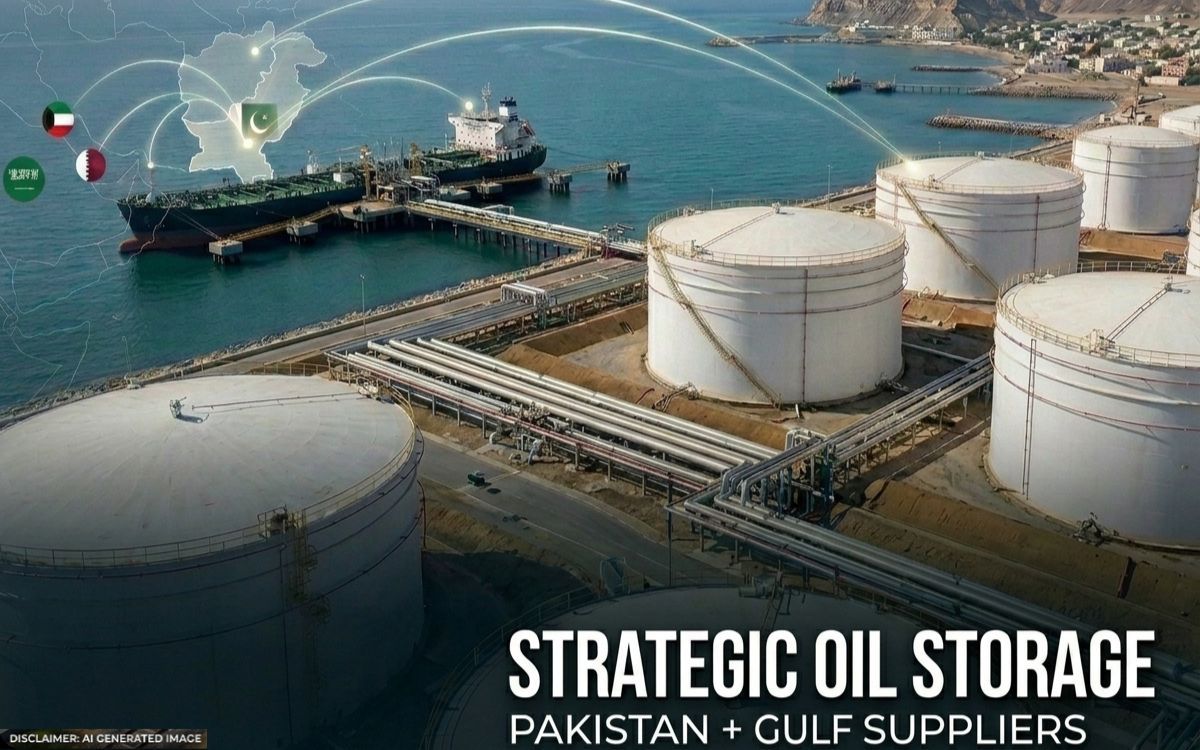
The scheme would cover crude oil, petrol, high-speed diesel, jet fuel, fuel oil, LPG and LNG. Proposed storage locations include Port Qasim, Karachi Port and Keamari, Hub, Gwadar, Mahmood Kot and Machike Sheikhupura.
The Petroleum Division is also seeking ECC approval for revised policy guidelines covering foreign supplier-funded imports through customs bonded storage facilities. The framework was initially approved by the ECC in June 2023, but no foreign supplier has established a bonded storage facility under the policy so far.
Under the revised framework, foreign suppliers would be able to maintain petroleum stocks in private or public bonded facilities and move products between approved locations through the national pipeline network without triggering duties or taxes while the products remain under the bonded regime.
Local sales would be made to licensed oil marketing companies and refineries, with applicable duties and taxes becoming payable when products are removed from bonded storage for domestic consumption. Foreign suppliers would also have flexibility to re-export their stored stocks.
OGRA would receive daily stock reports from consignees and establish product-specific safety and regulatory protocols for approved storage locations. The Federal Board of Revenue (FBR) would oversee customs requirements, while the Petroleum Division would serve as the lead coordinating authority.
The revised policy has been circulated among the Finance, Commerce, Industries and Production, Maritime Affairs and other relevant authorities. The FBR, however, has raised reservations over several provisions, particularly those related to the Customs Act and Sales Tax Act.
Malik said Pakistan’s limited strategic petroleum reserves have increased the country’s vulnerability to international supply disruptions. He estimated that maintaining one month of crude oil reserves would require around $500 million, while an underground storage system could require an additional $300 million to $400 million.
Pakistan currently imports around 90 percent of its energy requirements. Domestic oil production stands at approximately 70,000 barrels per day against daily demand of roughly 500,000 barrels. The government is therefore also seeking to increase domestic exploration and introduce measures to reduce exposure to international supply shocks.
The proposed storage arrangement follows disruptions to oil supplies through the Strait of Hormuz, which highlighted Pakistan’s dependence on imported energy. The government is also developing a broader energy roadmap, while Turkish Petroleum is expected to begin offshore drilling operations in Pakistan’s territorial waters.